New Express Entry Rules 2026: More CRS Points for Skilled Workers With Canadian Experience and Job Offers
Canada has announced one of the most significant and encouraging changes to Express Entry in recent years. Starting November 3, 2026, the Comprehensive Ranking System will give greater weight to skilled workers who have already demonstrated their ability to succeed in the Canadian labour market.
The changes are particularly important for professionals who came to Canada years ago, built Canadian careers, gained skilled work experience and established relationships with Canadian employers, but still found themselves struggling to achieve a competitive CRS score. Under the new system, qualifying Canadian work experience in eligible high-wage occupations can generate additional CRS points, while qualifying job offers in those occupations can provide 50, 70 or even 100 points.
Canada is also removing the Labour Market Impact Assessment, or LMIA, requirement for a job offer to qualify for these new Express Entry points. Having an LMIA will no longer provide additional CRS points or priority to a candidate.
The Government of Canada describes the objective of the reform as attracting and retaining skilled talent, identifying newcomers who are well positioned to succeed in Canada and making Express Entry more responsive to Canada's labour-market needs.
For skilled workers who have already spent years building their careers in Canada, this represents a meaningful change. The CRS will now place considerably greater value on demonstrated labour-market integration, particularly when Canadian experience has been gained in occupations associated with higher wages.
For many candidates, this could substantially change their Express Entry strategy.
Canada Is Giving More Weight to Skilled Workers Who Have Already Built Careers Here
For years, Canada has attracted international students, temporary foreign workers and skilled professionals from around the world. Many of these individuals came to Canada, gained professional experience, developed Canadian networks, progressed into increasingly skilled positions and became valuable contributors to Canadian employers and communities.
At the same time, some of these workers have faced an increasingly difficult transition to permanent residence. A professional could have several years of Canadian work experience, a stable position with a Canadian employer and a strong professional profile, yet still struggle to reach the CRS scores required in Express Entry invitation rounds.
The November 2026 changes represent an important shift in that equation. Rather than considering only how long someone has worked in Canada, the CRS will now also recognize whether qualifying Canadian work experience was accumulated in an occupation that IRCC has classified as high-wage. Qualifying job offers in those occupations will also return to the CRS and may provide substantial additional points.
This direction did not appear without context. During IRCC's 2026 consultations on Express Entry reform, participants raised concerns that invitation thresholds had become difficult for many qualified candidates to reach despite their education and work experience. Feedback also called for greater recognition of people who had already established themselves in Canada through work, study and tax contributions, while concerns were raised that the existing age-point structure could disadvantage mid-career and other highly skilled professionals.
The final reform does not eliminate all of those challenges, but it creates a clearer connection between demonstrated success in the Canadian labour market and a candidate's CRS score. For skilled professionals already working in Canada, that is a positive development.
What Changes on November 3, 2026
IRCC is introducing a new component of the Comprehensive Ranking System called the Labour Market Integration factor.
Under this factor, a candidate can receive points based on qualifying Canadian work experience, including additional points for experience accumulated in eligible high-wage occupations, or based on a qualifying job offer in an eligible high-wage occupation.
Candidates who potentially qualify under both calculations will not receive both sets of points. IRCC will calculate the score based on Canadian work experience and the score based on the qualifying job offer, then award whichever produces the higher Labour Market Integration score.
The maximum Labour Market Integration score is 150 CRS points for a candidate without an accompanying spouse or common-law partner and 140 points for a candidate with an accompanying spouse or partner when the score is based on Canadian work experience. A qualifying job offer can provide a maximum of 100 points.
The reform therefore gives Canadian labour-market participation a much more significant role within the CRS.
Canadian Work Experience Can Now Be Worth Up to 150 CRS Points
Candidates will continue to receive CRS points according to the length of their qualifying Canadian work experience. IRCC calls these work-length points, and the eligibility requirements for qualifying Canadian work experience are not changing.
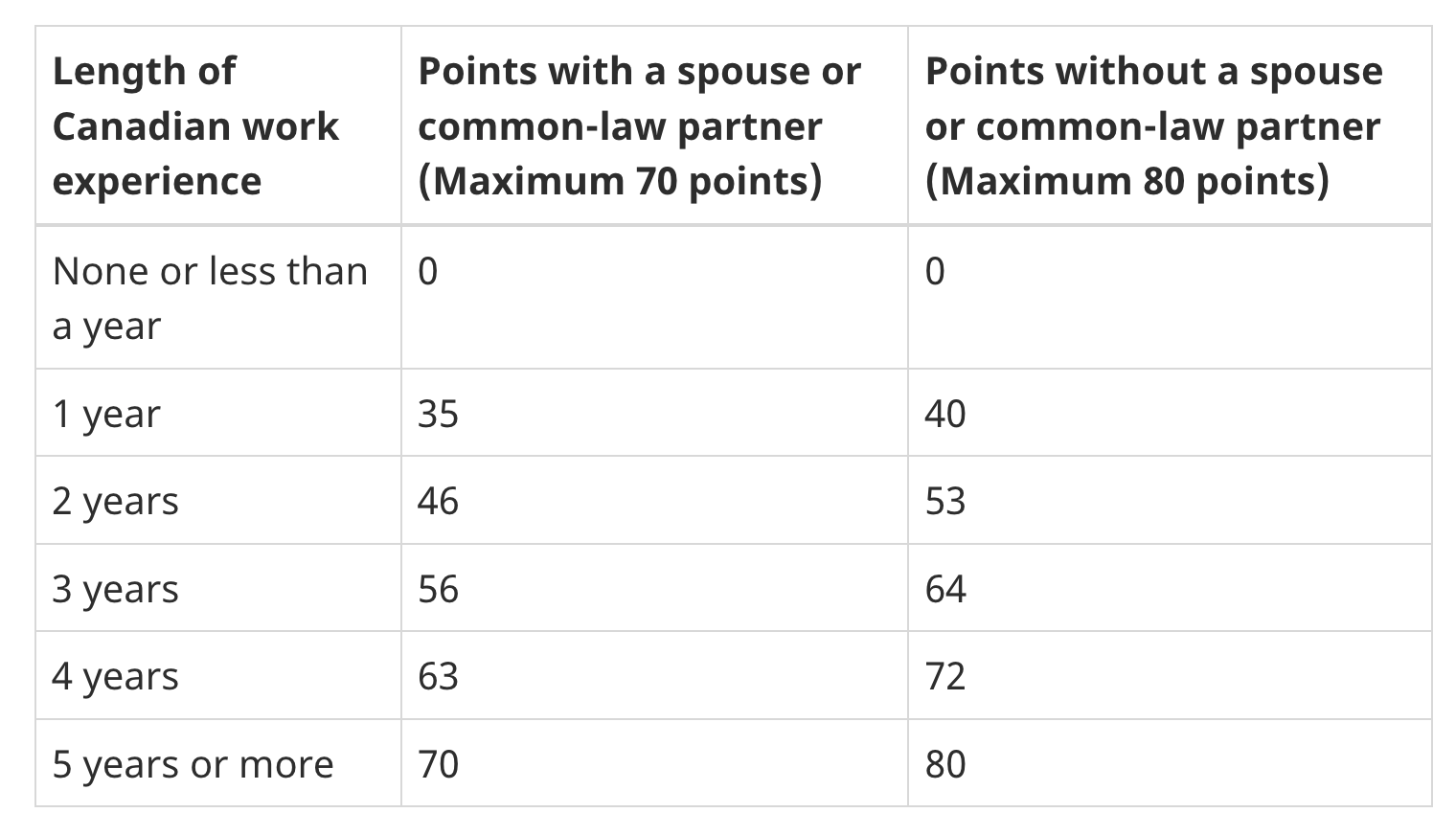
The major change is the introduction of additional points for candidates who have accumulated at least 12 months, or 1,560 hours, of qualifying Canadian work experience in one or more eligible high-wage occupations.
These points are added to the existing work-length points. Eligible Canadian experience may be continuous or non-continuous, full-time or the equivalent amount of part-time employment, and may be combined across more than one eligible high-wage occupation, provided the applicable requirements are met.
This is how the new maximum reaches 150 points. A candidate without an accompanying spouse who has five or more years of qualifying Canadian work experience can receive 80 points for the length of that experience. If at least 12 months of qualifying experience also meets the requirements for the highest high-wage level, another 70 points can be added, producing a Labour Market Integration score of 150.
For a candidate with an accompanying spouse or common-law partner, the corresponding maximum is 140 points.
It is important to distinguish the maximum total from the number of new points being introduced. The 150-point maximum includes the Canadian work-experience points that already existed. The new high-wage component adds a maximum of 70 points.
Why This Could Be Particularly Important for Experienced Professionals
The new system could be particularly meaningful for professionals who have been in Canada for several years.
Consider someone who arrived in Canada, obtained work authorization and gradually progressed through the Canadian labour market. Over time, that person may have developed specialized expertise, moved into a management or professional role, increased their earnings and become an important employee within a Canadian organization.
That professional may simultaneously have been losing CRS age points. This has created a difficult situation for some mid-career workers. Their professional value and Canadian labour-market experience were increasing while one of the most important components of their CRS score was decreasing.
IRCC's 2026 Express Entry consultation report specifically recorded feedback that the age-point structure could disadvantage mid-career professionals and other highly skilled workers, particularly after job-offer points had been removed. The consultations also recorded support for placing greater weight on individuals who had already established themselves in Canada through work, study and tax contributions.
The November reform does not remove the CRS age calculation, but it does give qualifying Canadian work experience in high-wage occupations considerably greater weight. For some experienced workers, those additional 20, 40 or 70 points could materially change their competitiveness in the Express Entry pool.
Job Offers Are Returning to the CRS
The second major change is the return of CRS points for qualifying Canadian job offers.
Canada removed CRS points for arranged employment in March 2025. Starting November 3, 2026, job-offer points will return under a new structure focused specifically on eligible high-wage occupations.
High-wage occupation level = CRS points for a qualifying job offer
Median wage at least 2× the average median wage = 100
Median wage at least 1.5× but less than 2× = 70
Median wage at least 1.3× but less than 1.5× = 50
Occupation not on the high-wage list = 0
This means that a qualifying Canadian job offer can potentially add as many as 100 CRS points.
The new structure also broadens the way qualifying job offers can be assessed. IRCC states that job offers may be for an existing or new position and may be with an existing or new employer, provided all applicable requirements are met.
For skilled professionals with genuine Canadian employment opportunities, the return of job-offer points could therefore become an important part of Express Entry planning.
The LMIA Requirement Is Being Removed
One of the most important elements of the reform is the removal of the LMIA requirement from the Express Entry job-offer assessment.
Starting November 3, a candidate will not need a positive Labour Market Impact Assessment for a job offer to qualify for program eligibility or the new CRS job-offer points. Having an LMIA will also not provide additional CRS points or give the candidate's profile priority.
This removes a significant barrier from the previous system. An LMIA is an employer-driven process that can require recruitment activities, government processing and employer participation. Under the new Express Entry rules, the existence of a genuine qualifying job offer rather than the existence of an LMIA becomes central to the assessment.
This does not mean that any employment letter will generate 50, 70 or 100 points. IRCC will continue assessing qualifying job offers when the permanent residence application is reviewed, and an officer must be satisfied that the offer is genuine.
The officer may consider whether the employer is actively operating the business, whether the position reflects a reasonable employment need, whether the employer can fulfill the terms of the offer, whether applicable employment and recruitment laws have been followed, and whether the candidate is qualified and able to perform the work. A job offer that is revoked will no longer qualify.
The reform therefore reduces the importance of the LMIA for Express Entry while increasing the importance of having a genuine, properly structured and properly documented employment relationship.
What Counts as a Qualifying Job Offer
The removal of the LMIA requirement should not be confused with the removal of job-offer requirements.
For the new CRS job-offer points, the position must be in one of IRCC's eligible high-wage occupations and the offer must satisfy the Express Entry requirements. A qualifying offer must generally involve full-time, continuous work in Canada for at least one year after the candidate becomes a permanent resident. Specific provisions apply to certain occupations, including skilled trades and physicians providing publicly funded medical services.
This distinction will be particularly important for candidates who are already working in Canada. A work permit and a qualifying Express Entry job offer are not necessarily the same thing, and being employed by a Canadian company does not automatically establish entitlement to the new job-offer points.
At the same time, a candidate who does not qualify for job-offer points may still receive Labour Market Integration points through qualifying Canadian work experience. Candidates who potentially qualify under both calculations will receive whichever calculation produces the higher score.
For this reason, Canadian workers should assess their complete employment situation rather than focusing exclusively on whether they possess a job-offer letter.
“High-Wage” Is Based on Your Occupation, Not Simply Your Personal Salary
One of the most important aspects of the new system is the way IRCC defines a high-wage occupation.
The classification is not determined simply by looking at how much an individual candidate earns. Instead, IRCC looks at the median wage of workers across Canada employed under the same National Occupational Classification, or NOC.
For Express Entry purposes, IRCC considers an occupation high-wage when the median wage of people working in that occupation is at least 1.3 times the average median wage of the overall Canadian workforce.
IRCC then divides eligible occupations into three levels: occupations whose median wage reaches at least twice the average median wage, occupations at least 1.5 times but less than twice the average, and occupations at least 1.3 times but less than 1.5 times the average.
The initial list taking effect November 3, 2026 is based on wage data from 2023 through 2025. IRCC uses information from the Job Bank, Labour Force Survey and Census of Population and assigns each NOC the highest high-wage level that its median wage met during the relevant three-year period.
This makes accurate NOC classification more important than ever. A candidate's personal salary may be high, but that alone does not establish eligibility for high-wage occupation points. The candidate's actual employment must correspond to the appropriate NOC, and that NOC must appear on IRCC's eligible list.
The Official Express Entry High-Wage Occupation List
The new list is broader than many candidates may expect. It includes occupations across management, healthcare, engineering, technology, education, finance, public administration, skilled trades, transportation and other professional fields.
The list below is based on IRCC's official high-wage occupation list published on October 16, 2026 and taking effect November 3, 2026. Because IRCC will maintain this list using updated wage data, candidates should always verify their NOC against the current government list before relying on a particular point calculation.
Which Occupations Qualify Under the New Express Entry Rules?
IRCC has published the complete list of high-wage occupations that qualify under the new Labour Market Integration factor. Eligible occupations are divided into three wage levels, which determine whether qualifying Canadian work experience may generate 20, 40 or 70 additional CRS points and whether a qualifying job offer may generate 50, 70 or 100 CRS points.
The list includes occupations across management, healthcare, technology, engineering, education, finance, public administration, skilled trades, transportation and other professional fields. Because IRCC will maintain and update the high-wage occupation list using wage data, candidates should confirm their NOC directly on the official IRCC website rather than relying on a static list reproduced in this article.
Official IRCC high-wage occupation list: https://www.canada.ca/en/immigration-refugees-citizenship/services/immigrate-canada/express-entry/check-score/high-wage.html
Two Examples of How the New Rules Can Change a Profile
NOC 21222 – Information Systems Specialists appears in IRCC's 1.5-times high-wage group. A candidate with at least 12 months of qualifying Canadian work experience at the applicable level may therefore receive 40 additional high-wage occupation points. A qualifying job offer in the same NOC may instead provide 70 points.
NOC 60020 – Retail and Wholesale Trade Managers appears in the 1.3-times group. Qualifying Canadian work experience may therefore provide 20 additional points, while a qualifying job offer may provide 50 CRS points.
These examples also demonstrate why accurate NOC classification matters. The candidate does not qualify simply because a job title resembles one appearing on the list. The NOC must appropriately correspond to the work actually performed, and the experience or job offer must satisfy the applicable Express Entry requirements.
For some candidates who have been sitting in the Express Entry pool below recent invitation thresholds, the difference could be substantial enough to require a complete reassessment of their strategy.
Your NOC Has Become Even More Important
NOC classification was already a fundamental part of Express Entry. The November changes make it even more consequential because the NOC can now directly determine whether qualifying Canadian experience generates an additional 20, 40 or 70 points and whether a qualifying job offer generates 50, 70 or 100 points.
Job titles alone are not sufficient to establish the appropriate classification. Titles such as Operations Manager, IT Manager, Business Analyst, Consultant, Store Manager or Project Manager can potentially correspond to different occupational classifications depending on the actual work performed.
Candidates should therefore resist the temptation to select a NOC simply because it appears in a higher wage category. The classification must be supported by the substance of the candidate's employment and the duties performed.
This is particularly important when two similar occupations fall into different high-wage levels. An incorrect classification made for the purpose of increasing a CRS score can create serious problems when IRCC later reviews the permanent residence application.
Candidates Already in the Express Entry Pool Will Be Recalculated Automatically
Candidates who already have an Express Entry profile do not need to create a new profile solely because of the November changes.
IRCC will recalculate existing profiles when the new rules take effect. The government states that the process may take up to two weeks and that invitation rounds will be paused while the recalculation is completed.
Candidates with job offers need to pay particular attention, however. IRCC is advising candidates who have a valid job offer that has not yet been included in their Express Entry profile to update their information before November 3, 2026.
This makes the period before implementation particularly important for people who are already working in Canada or who currently hold Canadian job offers.
IRCC's Online System Will Have a Temporary Workaround for Job Offers Without an LMIA
There is also an important implementation detail for candidates updating their profiles.
IRCC states that although the requirements will change on November 3, its online system will not immediately reflect the removal of the LMIA requirement. The Express Entry profile will temporarily continue asking candidates to indicate that a positive LMIA was issued.
IRCC has therefore published specific instructions for completing those fields when a candidate has a qualifying job offer without an LMIA, including temporary placeholder information.
Candidates should follow IRCC's published instructions exactly rather than attempting to create their own workaround. Because this is a transitional technical procedure, anyone updating an Express Entry profile after November 3 should check the current IRCC instructions before submitting the information.
A Job Offer Can Still Matter Even If the Occupation Is Not on the High-Wage List
Another important distinction is that job-offer points and Express Entry program eligibility are separate assessments.
A job offer in an occupation that does not appear on IRCC's high-wage list will receive zero job-offer CRS points under the new Labour Market Integration factor. That does not necessarily mean the offer has no immigration value.
IRCC confirms that a valid job offer may still help a candidate meet eligibility requirements under the Federal Skilled Worker Program or Federal Skilled Trades Program even when the occupation does not qualify for the new CRS job-offer points. For these programs, qualifying job offers are not limited to the high-wage occupation list and may be in an eligible TEER 0, 1, 2 or 3 occupation that meets the applicable program requirements.
This distinction is particularly important for Federal Skilled Worker candidates because program eligibility and CRS competitiveness should always be assessed separately.
The Federal Skilled Worker Eligibility Requirements Still Matter
The introduction of new Labour Market Integration points does not mean that every person with a qualifying high-wage job offer or Canadian work experience automatically becomes eligible for Express Entry.
Candidates must first qualify under one of the immigration programs managed through Express Entry. Federal Skilled Worker candidates, for example, must continue to satisfy the program's eligibility requirements. The CRS is then used to rank eligible candidates in the Express Entry pool.
A candidate may therefore have a strong projected CRS score under the November rules and still need to confirm that the underlying Express Entry program requirements are satisfied. This is another reason an accurate Express Entry assessment needs to go beyond entering numbers into a CRS calculator.
Skills Transferability Points Are Not Being Removed
IRCC has also confirmed that the rules governing skills-transferability factors are not changing as part of this reform.
Canadian work experience will continue to be assessed for skills transferability using the existing work-experience length requirements, without applying the new high-wage occupation requirements.
The new Labour Market Integration factor therefore works alongside the other components of the CRS rather than replacing them.
A complete calculation still needs to consider age, education, official-language proficiency, spouse factors where applicable, skills transferability, provincial nomination, French-language points and the other CRS components relevant to the candidate.
A Clearer Path for Canada to Retain Skilled Talent
The most encouraging aspect of this reform is larger than the individual point calculations.
Canada has spent years attracting skilled professionals, international graduates and temporary workers. Many of those individuals made significant decisions based on the possibility of building a future here. They studied, worked, paid taxes, developed Canadian experience and established careers with Canadian employers.
The transition from temporary residence to permanent residence has not always reflected how established some of these professionals have become in the Canadian labour market.
The November changes do not guarantee permanent residence for temporary workers, nor do they create a pathway for everyone currently in Canada. Express Entry remains competitive, candidates must satisfy the applicable program requirements, and receiving additional CRS points does not guarantee an Invitation to Apply.
Nevertheless, the policy direction is significant.
IRCC's announcement explicitly describes the reform as part of Canada's effort to attract and retain skilled talent and to identify skilled newcomers who are positioned to succeed in Canada. By giving additional weight to qualifying high-wage Canadian work experience and genuine high-wage job offers, the CRS is creating a stronger connection between demonstrated labour-market success and economic immigration selection.
For professionals who moved to Canada years ago and have since built successful careers here, that is a welcome development.
It also reinforces something I frequently discuss with my clients: career strategy and immigration strategy are increasingly interconnected. Occupation, professional progression, Canadian experience and the relationship with a Canadian employer can all influence the immigration opportunities available to a candidate.
Why Job Offer Review Is Going to Matter More
The removal of the LMIA requirement is excellent news, but it also creates the potential for significant misunderstanding.
A candidate may have a Canadian employer, a permanent position and a signed employment letter and still need to establish whether that employment actually constitutes a qualifying Express Entry job offer. The correct NOC needs to be confirmed, the occupation's high-wage level needs to be established, the terms of the offer must satisfy the applicable requirements, and the information in the Express Entry profile must accurately reflect the employment relationship.
For candidates who also have Canadian work experience, there is an additional calculation. The Canadian-experience Labour Market Integration score needs to be compared with the job-offer score because the two cannot be combined. IRCC will award whichever calculation produces the higher result.
The potential difference is substantial. A properly qualifying offer may be worth 50, 70 or 100 points. Qualifying Canadian experience may generate up to 150 Labour Market Integration points when work-length and high-wage points are combined.
When that many CRS points are potentially involved, relying on assumptions about a job title, NOC or employment letter can be an expensive mistake.
Express Entry & Job Offer Review
I have created an Express Entry & Job Offer Review for candidates who want to understand exactly how the November 2026 changes affect their profiles.
As a Regulated Canadian Immigration Consultant and a professional with more than 10 years of experience in human resources, recruitment and talent acquisition, I approach this assessment from both sides of the employment and immigration relationship.
The review assesses your Express Entry eligibility, current and projected CRS score, NOC classification, qualifying Canadian work experience, applicable high-wage occupation level and Canadian job offer. Where a job offer is being relied upon, the review also considers whether the employment information supports the requirements that need to be demonstrated before those points are claimed.
The objective is not simply to produce another CRS number. It is to determine whether the points can be legitimately claimed and properly supported in an Express Entry profile and eventual permanent residence application.
If you already have Canadian work experience or a Canadian job offer, this is the right time to have your profile reviewed before relying on your new CRS score.
Book an Express Entry & Job Offer Review
Frequently Asked Questions About the New Express Entry Rules
When do the new Express Entry rules take effect?
The new rules take effect on November 3, 2026. IRCC will recalculate existing Express Entry profiles, and the government says the process could take up to two weeks. Invitation rounds will be paused while the recalculation is completed.
Can I receive 150 new CRS points?
No. The 150-point figure represents the maximum total Labour Market Integration score for a candidate without an accompanying spouse or common-law partner when the score is based on Canadian work experience. It consists of a maximum of 80 work-length points plus up to 70 additional high-wage occupation points. The maximum new high-wage component is therefore 70 points.
How many CRS points can I receive for a Canadian job offer?
A qualifying job offer in an eligible high-wage occupation can provide 50, 70 or 100 CRS points, depending on the high-wage level assigned to the NOC.
Do I still need an LMIA to receive Express Entry job-offer points?
Starting November 3, 2026, an LMIA will no longer be required for a qualifying job offer to receive the new CRS points. Having an LMIA will not provide additional CRS points or give the candidate's profile priority.
Does my salary determine whether I receive 50, 70 or 100 points?
No. IRCC determines the high-wage level using the median wage of workers across Canada in the same NOC, rather than the individual candidate's personal salary.
I already work in Canada. Will I automatically receive additional CRS points?
Not necessarily. The Canadian experience must meet the existing Express Entry requirements for qualifying Canadian work experience. To receive the additional high-wage points, the candidate must also have accumulated at least 12 months of qualifying Canadian experience in one or more occupations on IRCC's eligible high-wage list.
I have Canadian work experience and a job offer. Can I receive both sets of points?
No. IRCC will calculate the Labour Market Integration score using Canadian work experience and using the qualifying job offer, then award whichever calculation produces the higher number of points.
Do I need to create a new Express Entry profile?
No. Existing profiles will be recalculated automatically when the new rules take effect. Candidates with qualifying job offers that are not currently included in their profiles should review and update their information before November 3.
Does my job offer have to be on the high-wage list?
To receive the new CRS job-offer points, yes. A job offer outside the high-wage occupation list receives zero points under that component. However, the offer may still be relevant to program eligibility under the Federal Skilled Worker Program or Federal Skilled Trades Program if it satisfies the applicable requirements.
Does receiving the additional points guarantee an Invitation to Apply?
No. Additional CRS points can improve a candidate's ranking, but an Invitation to Apply still depends on the type of invitation round, the candidate's overall CRS score and the applicable cutoff.
Where can I check whether my occupation qualifies?
IRCC has published an official high-wage occupation list identifying the eligible NOCs and their respective wage levels. Because the list may be updated as new wage data becomes available, candidates should verify the current IRCC list rather than relying exclusively on older articles or social-media posts.
This Is a Positive Change, but the Details Matter
For years, many skilled workers have done exactly what Canada traditionally encouraged them to do: build Canadian experience, develop their careers, contribute to Canadian employers and establish themselves professionally.
The November 2026 Express Entry reform gives that labour-market integration greater weight.
For some candidates, the change may mean an additional 20 points. For others, it could mean 40 or 70 additional points for Canadian work experience. A qualifying job offer may be worth 50, 70 or even 100 CRS points.
Those differences can be significant in a competitive Express Entry system.
The change is also an important signal about Canada's economic immigration direction. IRCC is explicitly focusing the CRS more heavily on skilled talent, economic outcomes and labour-market integration, while removing the LMIA requirement from qualifying Express Entry job offers.
For skilled professionals who have already built careers in Canada, this is genuinely encouraging news.
The next step is to determine what the change means for the individual profile. Candidates should confirm their NOC, review their Canadian work experience, assess any Canadian job offer and recalculate their CRS under the November rules before making decisions based on their previous score.
Have Canadian work experience or a Canadian job offer? Book an Express Entry & Job Offer Review to have your eligibility, NOC, job offer and new CRS calculation professionally assessed before relying on the additional points.
Fabiana Colen
Regulated Canadian Immigration Consultant (RCIC)
Licence R1041330
Colen Immigration
Sources:
IRCC — 2026 Changes to Canadian Work Experience and Job Offers
High-wage occupations and how we assess them
IRCC — Express Entry job-offer requirements
IRCC — October 16 announcement on attracting and retaining skilled talent.
This article provides general information and does not constitute individualized immigration advice. Express Entry requirements, CRS criteria and occupational classifications may change. Information in this article was reviewed against official IRCC guidance published October 16, 2026.